
Crenshaw County Civil Docket Searches
For a remote Crenshaw County docket search, start with AlacourtACCESS, also called Just One Look. It is the official paid source for Crenshaw County Circuit and District civil records. It covers Civil, Small Claims, Domestic Relations, and Child Support. Searching by name or case number costs $9.99 and includes one case detail. Search by number when you can. It is more precise. It spares you paying for a record that belongs to someone with a similar name. Copy the number exactly, keeping every dash, decimal, and division code from the filed paper.
The paid system is not the only door. Under Rule 401, the public gets free viewing. Circuit and District electronic court records can be seen at the clerk's office. Call (334) 335-6575 to confirm which office holds a file, a setting, or copies. The clerk sits in Suite 206 at 29 South Glenwood Avenue in Luverne. Hours are 8:30 a.m. to 4:30 p.m. weekdays. Mail works too: send a detailed request to P.O. Box 167, Luverne, AL 36049.
- Identify Circuit, District, Small Claims, Domestic Relations, or Probate from the paper and case code.
- Search AlacourtACCESS with the complete number or a party name.
- Open the matching case and read the newest Case Action Summary entries.
- Match a motion or setting with the later ruling, reset, or signed notice.
- Ask the correct clerk for a filed image, plain copy, or certified copy when needed.
Crenshaw Civil Codes Tell the Court
Local public notices reveal three civil division patterns worth knowing. Circuit civil work carries 24-CV-year-sequence, District civil matters use 24-DV-year-sequence, and Small Claims shows 24-SM-year-sequence. The county code 24 comes first in each. Treat these as format examples. Never use them to guess a private party's case number.
- CV
- Circuit civil, where general-jurisdiction civil matters are heard.
- DV
- District civil, a limited-jurisdiction civil division.
- SM
- Small Claims, a District Court division counted separately in state reports.
- Case style
- The short caption that identifies the sides by their roles.
Check the code first, because "civil" spans more than one docket. Wills, estates, guardianships, adoptions, and commitments stay with the Crenshaw County Judge of Probate, not the Circuit Clerk.
Civil Dockets: What They Show
A Crenshaw County civil Case Action Summary reads like a timeline. It can show a complaint filed, service issued, an answer received, a motion placed before the court, a setting made, or a judgment entered. The full text of each paper may not appear. AlacourtACCESS advertises actions and rulings, settings, parties, financials, and available images. The actual case file decides. It settles whether an image exists and what labels carry. Check there.
| Identity | Case number, division, filed date, court, style, status, and party roles. |
|---|---|
| Opening filing | Complaint or petition and related filing activity. |
| Service | Issuance and return entries showing steps taken to give formal notice. |
| Motions and orders | Dated requests paired with later court rulings when entered. |
| Settings | Advertised Court Setting Dates, with details confirmed through the latest notice or clerk. |
| Result | Judgment, dismissal, default, nonsuit, or other disposition as actually recorded. |
| Enforcement | Garnishment, execution, or appeal activity after judgment. |
The summary tells you where an event sits. For what the complaint, motion, order, or judgment actually says, pull the filed image itself.
Crenshaw Garnishment Notices After Judgment
Post-judgment work shows up locally through the Circuit Clerk's public garnishment notice table. Its columns include Name, Case Number, Notice of Garnishment, Written Court Order, and Publish Date. That layout marks a line. It separates the court's judgment from a later step taken to enforce it. Use the table without repeating private names or identifiers.
| Entry | What it means | What to verify |
|---|---|---|
| Judgment | The court's enforceable decision | Signed order, date, and relief |
| Notice of garnishment | Notice of a post-judgment collection process | Related case number and dates |
| Written court order | A ruling entered in that enforcement stage | Actual order image or certified copy |
A garnishment notice is not proof that everything requested was granted. Before concluding anything, read the later orders and the underlying judgment.
Rebuild the civil sequence in order. Complaint or petition, service, answer, motion, order, setting, judgment, enforcement follow in turn. Not every file will contain every step. A settlement can end a dispute before trial. A default is different. It needs a court entry rather than a reader's guess. For garnishment, track both the public notice and any later written order. If an appeal appears, note which court received it. Search the new number there.
What Cases Fill the Civil Docket
Crenshaw Circuit Court carries general civil and domestic-relations matters. District Court handles Small Claims and other lower civil work. The 2023 state report counts Circuit civil and domestic filings separately. District filings are separate too. Small Claims and other civil filings get their own shares. The county's official pages skip clear current dollar thresholds. For jurisdiction questions, rely on the case paper or ask the clerk.
| Record type | Likely court | Custodian |
|---|---|---|
| General civil or domestic matter | Crenshaw Circuit Court | Circuit Clerk |
| Small Claims or lower civil matter | Crenshaw District Court | Circuit Clerk |
| Estate, will, guardianship, adoption, or commitment | Crenshaw Probate Court | Judge of Probate |
| Appeal from District or Municipal Court | Crenshaw Circuit Court | Circuit Clerk for the new appeal case |
An appeal creates a new Circuit case. Follow the receiving court's number from that point, since later events will not all stay on the old lower-court docket.
Crenshaw Civil Filings in Perspective
The FY2023 Alabama court report counted 544 total Circuit Court filings in Crenshaw County. General civil matters made up 13 percent. Domestic matters made up 28 percent. District Court received 3,761 filings overall. Small Claims was 8 percent, and other civil was 2 percent. Those numbers explain why a docket search must name the civil division rather than treating the courthouse as one broad file cabinet.
These countywide totals count Crenshaw County civil filings across a full fiscal year. They say nothing about how long any single case takes.
Hearings on the Civil Docket
A filing date and a hearing date answer two different questions in a Crenshaw County civil case. The filing date tells you when paperwork landed. The hearing date tells you when the court will take it up. Always start with the newest setting in the civil docket. Then scan the later entries for a continuance, a reset, or a signed notice. A motion entry only shows the request reached the court. It is not a ruling. Only a later order tells you how the judge decided. The same caution goes for answers and defaults: an entry showing no answer, by itself, does not prove a default judgment was entered.
AlacourtACCESS lists Court Setting Dates, but it publishes no schedule for refreshing them. Call the Circuit Clerk for a hearing coming up soon. Confirm the latest date, time, court or division, location, setting type, and any newer order. One case can carry several settings. Motion, status, pretrial, and trial events each get their own date.
Note: The latest signed setting notice controls. An older date that remains visible earlier in the docket chronology does not override it.
Federal Civil Records Are Separate
Some civil suits born in Crenshaw County never touch the state courts at all. A federal civil dispute stays out of the state civil Case Action Summary. Crenshaw County sits in the Northern Division. That division belongs to the U.S. District Court for the Middle District of Alabama. That court runs its own filing and docket systems. Those systems are CM/ECF and PACER. The Middle District CM/ECF entry point shows that separate federal system and its own dockets, fees, and rules.
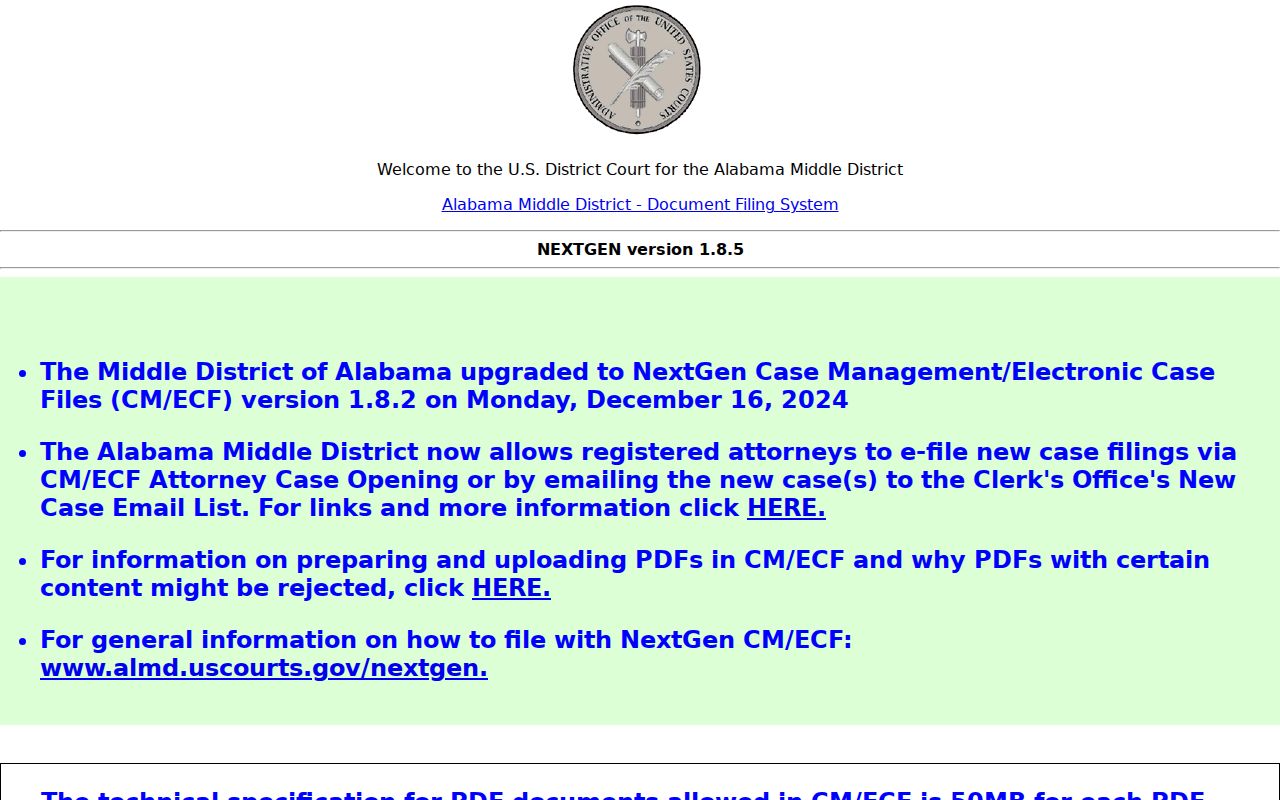
The boundary is simple. A PACER or CM/ECF entry has limits. It cannot replace the state Circuit or District civil record the Crenshaw County Circuit Clerk holds. State and federal facts can overlap. Even so, each court assigns its own case number, filings, orders, and appeal route. Search both systems only when the case documents show that both proceedings actually exist.
Who Can See Civil Dockets
Anyone can inspect the ordinary public Crenshaw County civil dockets under Alabama's court-record rules. Rule 104 allows inspection and copying. A law, another rule, or an order can make the material confidential, restricted, or sealed. Rule 401 goes further. It gives free viewing of Circuit and District electronic dockets at the clerk's office. Remote access through AlacourtACCESS is paid, and copy and certification charges may apply.
Civil privacy boundary: Rule 301 governs sealing, and Rule 303 requires core personal identifiers to be redacted. Alabama Civil Rule 5.1 also addresses identifier redaction in civil filings.
Some things stay out of the normal public view. Protected family details, juvenile matters, and sealed records may not appear there. A missing record has other explanations too: the wrong division, a changed case number, an older file, or a Probate Court matter that sits outside the Circuit Clerk's system.
Certified Crenshaw Civil Judgments
A portal summary carries no certification on its own. If you need formal proof of a civil judgment in Crenshaw County, pin down the exact order by case number, case style, and entry date. Ask the Circuit Clerk whether a scanned image exists, then request either a plain copy or a certified one. The clerk sets no published Crenshaw request form, no certification surcharge, no accepted-payment list, and no turnaround promise. So call before you mail any money.
Put the essentials in a mailed request: your contact details, the Circuit or District division, the exact case number, the case style if you know it, the document title and date, the copy type you want, and how it should be delivered. Rule 401 requires the requester to pay postage. Before drafting that copy request, the Crenshaw County docket search process can help you locate the right case in the court docket.
Transcripts are a different matter entirely. The official court reporter builds the word-for-word record of what happened at a hearing and fields transcript requests tied to an appeal. A civil docket entry proving a hearing took place does not mean the Circuit Clerk can hand you a transcript. Availability, cost estimates, deposits, and delivery timelines all belong with the reporter. Pleadings, orders, judgments, and docket copies still go to the clerk.
Only the clerk can authenticate a certified judgment. A saved image of the docket may help you track a Crenshaw County court record, but it carries no clerk certification and proves nothing formal.